No. 235Language3 minviews 41
Published by GK Library Annex
How does an eraser remove pencil marks?
An eraser doesn't dissolve the writing; it grabs the graphite dust sitting on the paper and pulls it away.
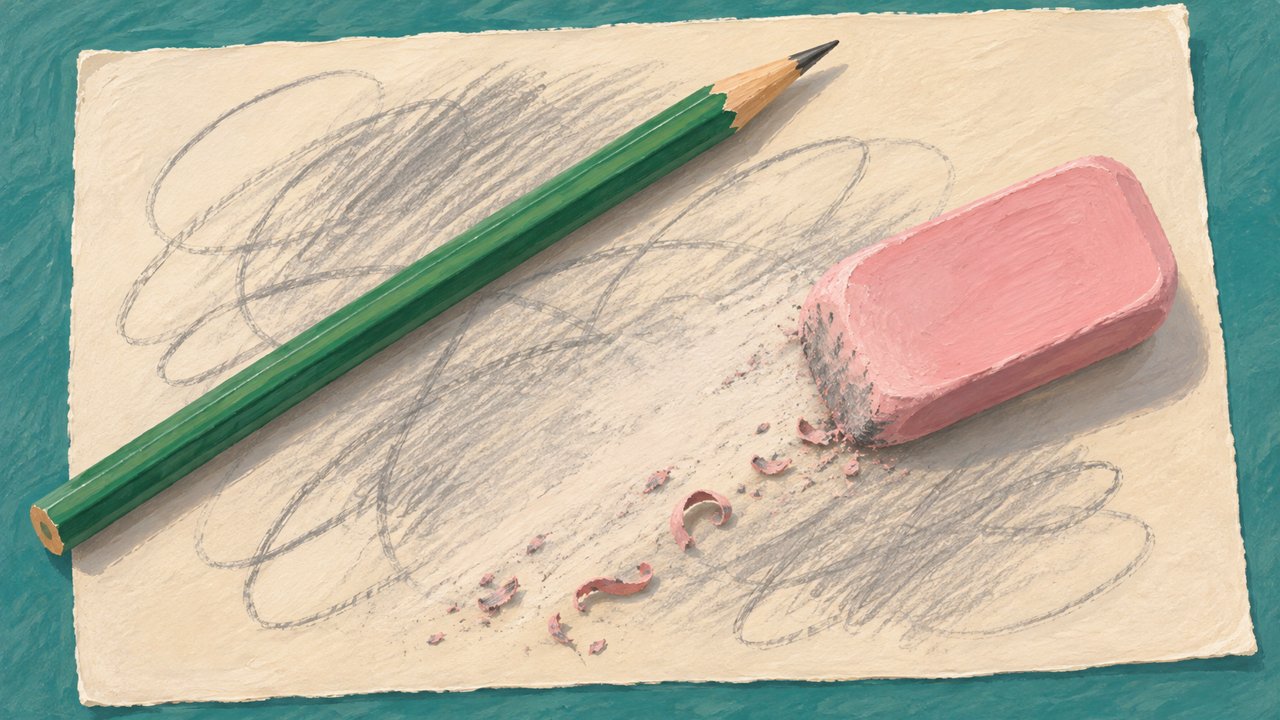
Rub with an eraser and pencil writing disappears. But the eraser isn't melting or destroying the marks. It's closer to grabbing the graphite dust resting on the paper's surface, more stickily than the paper does, and carrying it off in the eraser crumbs.
Pencil marks sit on top of the paper
A pencil lead is graphite mixed with clay and baked. Graphite is built from thin sheets stacked in layers, so when you drag it across paper, tiny flakes slide off easily. Those flakes catching on the rough surface of the paper fibers are what we see as pencil writing.
The key point is that graphite doesn't soak into the paper. Most of it just rests loosely on or between the fibers. That's why it smudges when you rub it with your hand, and why it readily moves to anything stickier that comes along.
The eraser carries the dust away
As you rub, friction wears the eraser's surface down a little at a time, making crumbs. The eraser material clings well to graphite flakes, so it pulls the dust off the paper and wraps it up inside the crumbs. That's why eraser crumbs turn greyish. Brush them away and the graphite goes with them.
That rubber could erase pencil marks became known in England around 1770. The chemist Joseph Priestley described it, and there are records that the instrument maker Edward Nairne sold rubber for erasing. Before that, people reportedly used pieces of bread. Today, most white erasers aren't natural rubber but plastics such as PVC mixed with softening ingredients.
Why won't ballpoint pen erase?
Ink from ballpoint or fountain pens is a liquid that soaks into the paper fibers and dries there. It isn't dust sitting on top, so the eraser has almost nothing to grab. To remove it, you'd have to scrape away the paper's surface.
Pencil is hard to erase too if you press hard. The graphite gets pushed deep into the fibers and the paper even gets grooved. Dark leads like 4B hold more graphite and smudge easily, but lightly drawn lines usually erase fairly cleanly.
An eraser grips the graphite dust lying on the paper more stickily than the paper does and carries it off in crumbs. That's also why soaked-in ink won't erase.
Notes and references · Science History Institute, Smithsonian, Scientific American. The layered structure of graphite and the crumb mechanism are general explanations. Priestley's 1770 description, Nairne's sales and the bread story are handed-down records, and exact dates vary slightly between sources.
Editorial standardsReport an error
Quick quiz