No. 185Nature3 minviews 69
Published by GK Library Annex
How much of a mountain has to turn color for peak autumn foliage?
The Korea Meteorological Administration logs the first foliage when 20% has turned from the summit down, and the peak when 80% of the whole mountain has
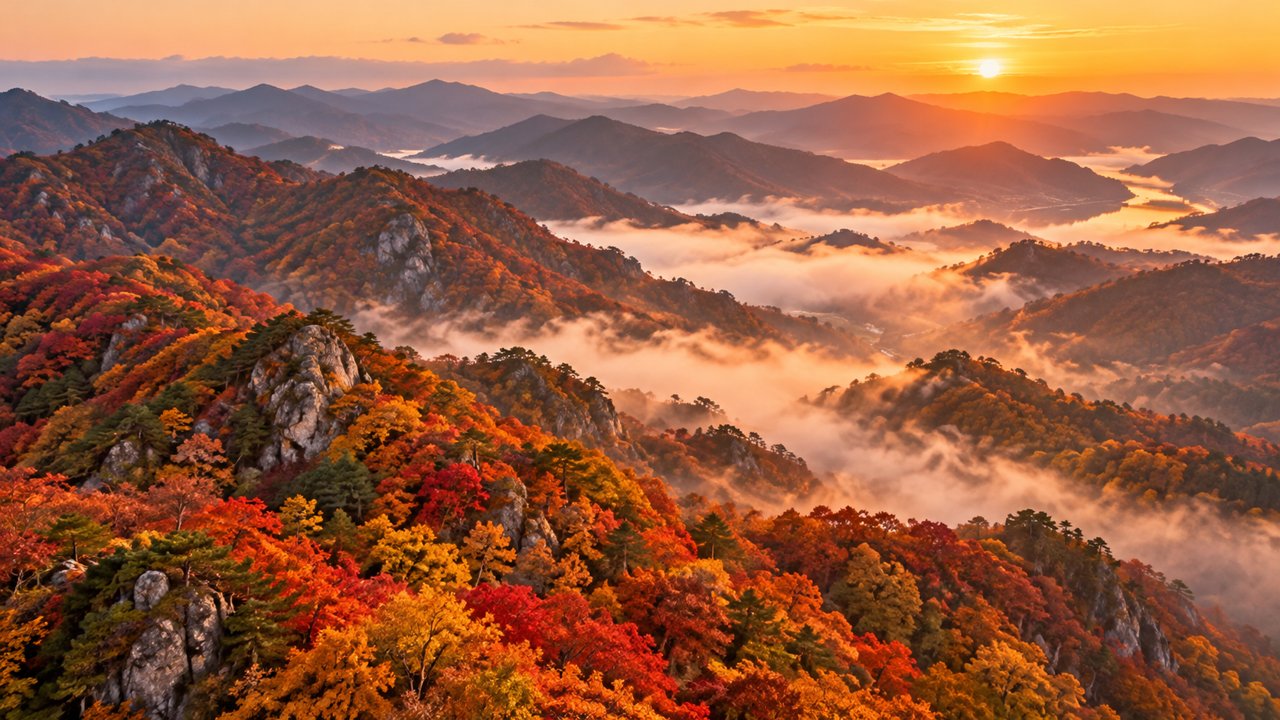
Peak autumn foliage means about 80% of the whole mountain has changed color. The Korea Meteorological Administration (KMA) records the first foliage when about 20% has turned, starting from the summit, and the peak when roughly 80% of the whole mountain has turned.
The 20% and 80% standard
To track seasonal change and long-term climate trends, the KMA observes the autumn leaves on 21 well-known mountains across Korea. Looking at each mountain as a whole, it records the first foliage when about 20% has turned color from the summit down, and the peak when about 80% of the entire mountain has turned.
Away from the mountains, it watches standard observation trees chosen for each area, such as maples and ginkgos. For these, foliage begins when about 20% of a single tree's leaves have turned, and peaks at about 80%. In other words, mountains are judged by the whole mountain, and trees by their leaves.
Why the summit turns first
Leaves usually start to change color once the daily minimum temperature drops below 5°C. Because it gets colder the higher you go, the summit of a mountain cools first and turns first. That is why the first foliage is measured from the summit down.
For the same reason, autumn colors generally move from north to south. Forecasts by private weather companies sometimes estimate that the foliage front moves south by about 20 to 25 km a day.
If you only trust the first-foliage news
When you hear that the first foliage has appeared, it is easy to assume the mountain is already red. But first foliage means only the area near the summit has turned a little. The peak usually comes about two weeks after the first foliage, and it can shift earlier or later depending on that year's daily temperature range and rainfall. If you want to see the whole mountain in color, it is better to aim for about two weeks after the first-foliage news.
Climate change, with its longer summers, also plays a part. Comparing the 1981-2010 normals with the 1991-2020 normals, the first foliage and the peak have come later than before on most of Korea's well-known mountains.
Checking the peak at a mountain near you
According to Korea's government news portal Korea.kr (Policy Briefing), the normal peak foliage date is October 17 for Seoraksan, and October 28 for both Bukhansan and Hallasan. For Bukhansan in Seoul, this time of year is right at the peak by the normal date.
For this year's conditions, you can check the first-foliage and peak observations for the 21 well-known mountains in the 「봄꽃·단풍」 (Spring Flowers & Autumn Leaves) menu of the KMA's Weather Nuri website. The normal dates are 30-year averages, so before heading out it is a good idea to check that year's observations as well.
Peak foliage is when about 80% of the whole mountain has turned, and it often comes about two weeks after the first-foliage news.
Notes and references · Korea.kr Policy Briefing: When should you go see the autumn leaves this year?. KMA standards of 20% for first foliage and 80% for the peak, and normal peak dates. The 5°C minimum temperature and the peak about two weeks later come from KMA press releases; the 20-25 km daily southward movement is a private company forecast.
Editorial standardsReport an error
Quick quiz